
Quick answer: Conservatory roof insulation reduces heat loss through your conservatory’s roof using materials such as multifoil blankets, PIR rigid foam boards, or insulated roof panels. The right solution depends on your roof type, budget, and how much you want to improve comfort. Most installations take one to two days and don’t require planning permission.
Your conservatory might be the most underused room in your house. Too hot in July, too cold in December, and draughty in between — that’s the reality for most UK homeowners with an uninsulated polycarbonate or glass roof. The good news is that the fix is more straightforward than you might think.
This guide covers everything you need to know about conservatory roof insulation: what it is, which materials work best, what the installation involves, what you can realistically expect in terms of comfort, and where the limitations lie. By the end, you’ll be equipped to make a confident, informed decision — whether that’s adding insulation to your existing roof or comparing it against a full roof replacement.
What Is Conservatory Roof Insulation?
Conservatory roof insulation is a layer of thermally resistant material fitted to the inside, outside, or within the structure of your conservatory roof. Its job is to slow the movement of heat — keeping warmth inside during winter and blocking solar heat gain during summer.
According to the Energy Saving Trust, an uninsulated home can lose around 25% of its heat through the roof. Conservatories — especially those with thin polycarbonate panels — perform far worse than the main house. Without insulation, the space becomes unusable for a significant portion of the year.
Effective insulation changes that. It regulates the internal temperature, reduces glare from direct sunlight, muffles rain noise on polycarbonate panels, and lowers the amount of energy needed to heat the space. The result is a conservatory you can actually use year-round, not just on mild spring days.
The three most common approaches are:
- Multifoil insulation — thin, reflective blanket-style layers fitted to the roof interior
- PIR rigid foam boards — dense, high-performance boards fixed between or below roof rafters
- Insulated roof panels — full internal panel systems that replace or line the ceiling
Each works differently and suits different roof types and budgets. We’ll cover them all below.
Material Options for Conservatory Roof Insulation
Choosing the right insulation material comes down to your roof structure, the level of performance you want, and how much headroom or light you’re willing to sacrifice.
Multifoil Insulation
Multifoil insulation — sometimes called reflective foil insulation — consists of multiple layers of aluminium foil, polyethylene bubble film, and mineral wool fleece laminated together into a flexible blanket. Products like YBS SuperQuilt are popular choices for conservatory roofs.
According to technical guidance from NBS, multifoil systems work by reflecting long-wave radiant heat back into the room using low-emissivity aluminium surfaces. To perform correctly, they require an adjacent air cavity on at least one face — so installation method matters. The foil also functions as a vapour control layer, which means joints, laps, and penetrations need to be properly taped and sealed.
Pros:
- Slim profile — typically 3–30mm thick, so minimal impact on headroom
- Flexible and relatively easy to cut and fit
- Can double as a vapour control layer
- Suitable for DIY installation in straightforward cases
Cons:
- Performance is dependent on maintaining the required air cavity
- Surface emissivity degrades over time if dusty or contaminated
- Lower thermal resistance than thicker rigid board alternatives
Approximate cost: Materials typically range from £5 to £15 per m², making this one of the more affordable starting points.
PIR Insulation Boards (Rigid Foam)
Polyisocyanurate (PIR) boards are rigid, dense foam panels with foil facings on both sides. A well-known example is Celotex GA4000, which has a thermal conductivity of 0.022 W/(m·K) — one of the lowest available in a rigid board format. A 100mm board delivers a thermal resistance of 4.50 m²K/W, making it significantly more effective than multifoil at equivalent thicknesses.
PIR boards are used in roof, wall, and floor applications. For conservatories, they’re typically fitted between rafters or fixed to the underside of the roof structure, then finished with a plasterboard or panel lining.
Pros:
- High thermal performance relative to thickness
- Rigid and self-supporting — less prone to sagging than membranes
- Works well in both pitched and flat conservatory roof sections
- Lifespan of decades when correctly installed
Cons:
- Adds more depth than multifoil — can reduce internal height
- Requires boarding or lining to finish the interior
- More complex to install than flexible multifoil
- Not straightforward as a DIY project in most cases
Approximate cost: PIR boards typically cost £15 to £30 per m² for materials, plus labour.
Insulated Roof Panels
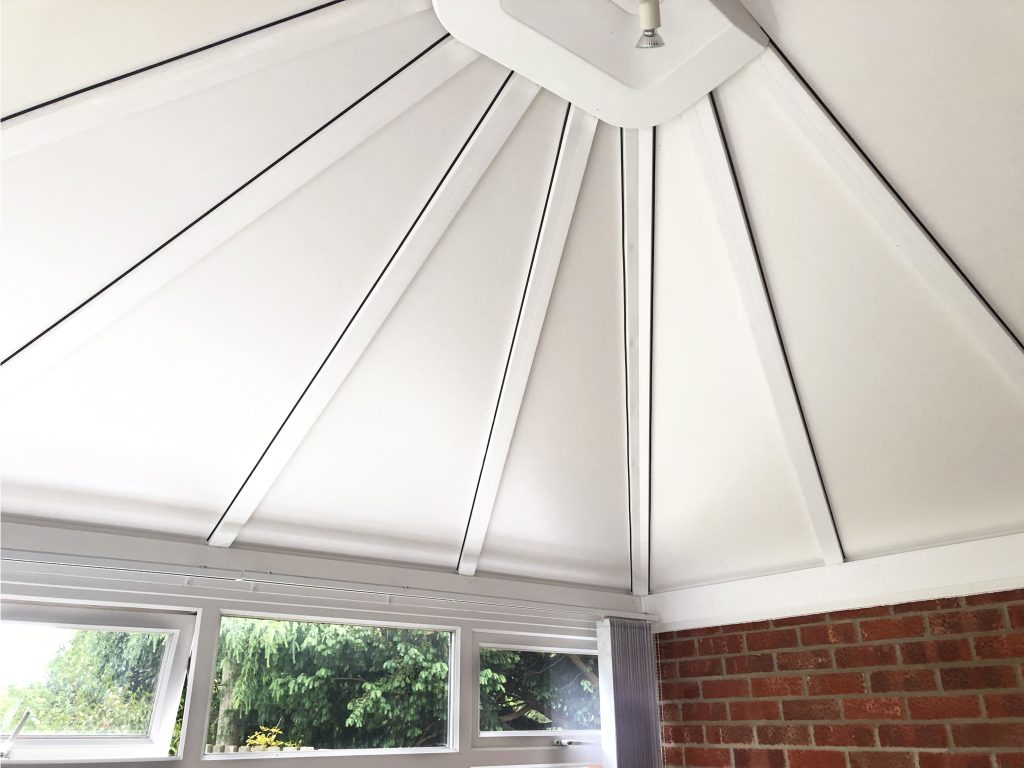
Cosy Panels are a typical example of insulated roof panels which are a step beyond material-only solutions. These are composite panel systems — often featuring a PIR core with decorative interior and exterior facings — that are fitted inside the conservatory to create a new insulated ceiling. They’re commonly used in conservatory upgrade projects rather than new builds.
Pros:
- High thermal performance combined with a finished aesthetic
- Significant noise reduction — particularly effective against rain on polycarbonate
- Can dramatically improve the feel of the space with minimal structural work
- Installation is typically completed within one to two days
Cons:
- Higher cost than loose materials
- Reduces internal height depending on panel depth
- Requires professional installation for best results
- May reduce natural light if opaque panels cover a large area of the roof
Approximate cost: Full insulated panel systems, including fitting, typically range from £4,000 to £10,000 depending on conservatory size and panel specification.
Installation Overview
How insulation is installed depends on the material and the roof type. Here’s a practical breakdown of each approach.
Multifoil Installation
Multifoil is the most accessible option for a confident DIYer with a straightforward pitched polycarbonate or glass conservatory roof. The process involves:
- Measuring and cutting the foil blanket to fit between rafters
- Stapling or fixing the foil in place, ensuring the required air gap is maintained
- Taping all joints, laps, and penetrations to maintain the vapour control layer
- Finishing with a lightweight lining board or leaving the foil exposed, depending on preference
Tools needed: Tape measure, stanley knife or scissors, staple gun, specialist foil tape – Time estimate: One to two days for a typical conservatory – Skill level: Moderate — achievable as DIY, but attention to the air cavity and sealing is critical
PIR Board Installation
PIR board installation is more involved and generally benefits from professional help, particularly for the final lining stage.
- Boards are cut to fit between or below roof rafters
- Fixed in place using appropriate adhesive or mechanical fixings
- Joints are taped to reduce air infiltration
- Interior is finished with plasterboard or a decorative panel
Tools needed: Saw, fixings, adhesive, tape measure – Time estimate: Two to four days including finishing – Skill level: Intermediate to advanced — professional installation is recommended for a neat result
Insulated Panel Systems
Full panel system installation is a professional job. A specialist will:
- Assess the existing roof structure and dimensions
- Fabricate or supply panels cut to size
- Fit panels to a framework within the conservatory
- Complete finishing, sealing, and clean-up
Time estimate: One to two days in most cases – Skill level: Professional only
Expected Comfort Improvements
Insulating your conservatory roof produces noticeable results across all four seasons — not just winter.
Temperature regulation is the primary gain. A properly insulated roof slows heat loss in winter and reduces solar heat gain in summer. Where an uninsulated polycarbonate roof can allow internal temperatures to exceed 35°C on sunny days, insulated panels bring that figure down to a comfortable range.
Noise reduction is significant, particularly for polycarbonate roofs. Heavy rain on an uninsulated polycarbonate sheet can make the space unusable for conversation or work. PIR-cored insulated panels absorb and dampen sound, producing a much quieter interior environment.
Reduced glare comes as a secondary benefit when panels replace or line a translucent roof. Direct sunlight no longer creates hotspots or screen glare, making the space more practical for working from home or family use.
Energy savings follow naturally from improved thermal performance. The Energy Saving Trust notes that reducing heat loss through the roof can lower heating demand and cut energy bills. The exact saving depends on your conservatory’s size, current performance, and how often the space is heated — but the direction of travel is consistently positive.
Year-round usability is the outcome most homeowners care about most. A conservatory that was previously shut off from October to April becomes a functional living room, home office, or dining area with the right insulation in place.
Limitations of Conservatory Roof Insulation
Insulation is not a universal fix, and it’s worth going in with realistic expectations.
Loss of natural light is the most common trade-off. Opaque insulation panels reduce or eliminate daylight through the roof. For some homeowners that’s acceptable — particularly if the space is used primarily in the evening — but others find it fundamentally changes the character of the room. Some panel systems incorporate translucent sections to partially address this.
Condensation risk is a genuine concern. Insulation changes the thermal behaviour of the roof structure, which affects where and how moisture condenses. Without adequate ventilation, this can cause damp or mould over time. Proper vapour control layers, correctly taped joints, and maintained ventilation paths are all essential — a point the Energy Saving Trust highlights as critical for any roof insulation project.
Building regulations may apply, particularly if you’re making significant changes to the thermal performance of the roof. The Planning Portal confirms that making significant changes to thermal elements normally requires Building Regulations approval and may require the element to be upgraded to a defined standard. Lightweight internal multifoil or panel systems typically fall below this threshold, but it’s worth checking with your local building control office if the scope of work is substantial.
Weight is a factor for solid or tiled insulated systems. Some older conservatory frames — particularly lightweight uPVC structures — may not support the additional load of heavy panel systems without reinforcement. A structural check before installation is advisable.
Performance limits also exist. Even with high-quality insulation, a conservatory is not the same as a fully integrated extension. Heat will still escape through the glazed walls and floor, and the space will always be more susceptible to temperature swings than a brick-built room.
Questions to Ask Installers
Finding the right installer makes a significant difference to the outcome. Use this list of questions to assess any company you’re considering.
About their experience:
- How many conservatory roof insulation projects have you completed?
- Can you share examples of similar projects, or customer references I can contact?
- Are you familiar with the specific roof type on my conservatory?
About materials and specification:
- Which insulation material do you recommend for my roof, and why?
- How do you handle condensation risk and vapour control?
- What U-value or thermal resistance will the finished installation achieve?
About compliance and credentials:
- Are you registered with TrustMark or a relevant trade association?
- Will the work require Building Regulations approval, and will you handle that?
- Do you carry public liability insurance?
About the project itself:
- How long will installation take, and what disruption should I expect?
- What does the quote include — materials, labour, finishing, and clean-up?
- What guarantee do you offer on the installation?
The TrustMark consumer guidance recommends getting at least three quotes, verifying qualifications, checking insurance, and being cautious of unusually low prices or high-pressure tactics. TrustMark is the UK government-endorsed quality scheme for home improvement work — using a registered business provides an additional layer of consumer protection.
Frequently Asked Questions
What is the best insulation for a conservatory roof? – The best option depends on your priorities. Multifoil insulation (such as YBS SuperQuilt) is the most affordable and DIY-friendly, making it a solid starting point for modest improvements. PIR rigid boards (such as Celotex GA4000) deliver higher thermal performance and suit homeowners who want maximum efficiency. Insulated roof panel systems offer the best overall result — thermal performance, noise reduction, and a finished interior — but at a higher cost and requiring professional installation.
Does conservatory roof insulation require planning permission? – In most cases, no. Adding insulation internally to an existing conservatory roof doesn’t typically require planning permission. However, significant changes to thermal elements may require Building Regulations approval. Check with your local building control authority if you’re unsure.
Will conservatory roof insulation block natural light? – Opaque insulation panels will reduce or eliminate light through the roof. Multifoil insulation fitted between rafters has a smaller visual impact but still reduces translucency. Some panel systems include translucent sections to preserve partial light. If natural light is a priority, discuss this explicitly with your installer before choosing a solution.
How long does conservatory roof insulation last? – High-quality rigid insulation boards and panel systems can last 20 to 40 years when correctly installed. Multifoil insulation is similarly durable, though performance can degrade slightly if the foil surface becomes dusty or the air cavity is compromised over time.
Can I insulate a conservatory roof myself? – Multifoil insulation is achievable as a DIY project for homeowners comfortable with practical tasks, provided the roof is safely accessible and the air cavity requirements are correctly met. PIR board and full panel system installations are better handled by professionals due to the finishing requirements and structural considerations involved.
Does conservatory roof insulation help with noise from rain? – Yes — particularly PIR-cored insulated panels. Replacing or lining a polycarbonate roof with insulated panels significantly reduces rain noise. Many homeowners describe the difference as transformative, particularly during heavy rainfall.
Is Insulation Enough, or Should You Consider a Full Roof Replacement?
Insulation improves what you already have. A full roof replacement changes the roof itself — and sometimes that’s the better long-term decision.
The key question is: what condition is your current roof in, and what level of performance do you want?
Insulation makes sense when:
- Your existing roof is structurally sound
- Your primary goal is improved comfort and noise reduction
- You want a lower-cost, faster solution
- You’re not ready to commit to a major renovation
Roof replacement makes sense when:
- Your polycarbonate panels are yellowing, cracked, or leaking
- You want to maximise thermal performance and room functionality
- You’re considering a tiled or solid roof to fully integrate the space with the house
- You’re preparing the property for sale and want maximum added value
According to Checkatrade’s 2026 UK price guide, conservatory roof replacement costs typically range from £6,300 to over £18,225, with an average of around £10,000. By material type:
- Polycarbonate replacement: from £6,300
- Tiled replacement: from £7,875
- Glass replacement: from £9,450
Compare that with insulated panel systems at £4,000 to £10,000, and the cost gap between insulation and a mid-range replacement is smaller than many homeowners expect. For a conservatory with a structurally sound frame but a poorly performing roof, insulation often delivers most of the comfort benefit at a fraction of the replacement cost. For a roof that is failing or at end of life, replacement makes more financial sense over the long term.
The right starting point is an honest assessment of your roof’s current condition — followed by quotes for both options so you can compare them on equal terms.